Union3.1 and UNITY1.8: Progress on Systematics, ~3 sigma LCDM Tension

Two important results today in supernova cosmology: a consistent set of host-galaxy stellar masses (Union3.1 led by Taylor Hoyt) and a new Bayesian model that solves for two SN Ia subclasses (UNITY1.8 by me). Both tackle one of our biggest challenges: astrophysical systematics.

Supernova cosmology uses standardizable candles (type Ia SNe, in this case) to measure distances in the universe. After standardization using their light curves, these SNe have about the same luminosity, so their apparent brightnesses tell us their distances.

The redshift of SN (or host galaxy) light gives the amount the universe has expanded since the SN exploded. Looking back over billions of years, the distance-versus-redshift relation traces the expansion of the universe, telling us about its history, composition, and fate.

In the 1990’s, SNe Ia provided strong evidence that the expansion of the universe is accelerating! Cosmologists named source of the acceleration, “dark energy.” It could be a cosmological constant but recent results hint at change in time, which would indicate new physics!

Many of the key challenges in supernova cosmology rely on trying to ensure that distant SNe and nearby SNe are standardized to the same luminosity. Sometimes, that’s under our control, like measuring the linearity of our cameras so that bright and faint sources can be compared.

But some of the most worrying effects are outside our control. How do we know that SNe billions of years ago had the same luminosity as SNe today? A trick that started to be used for the first results in the 90’s was to look at old and young galaxies at similar redshifts.

There are a range of galaxy ages at every redshift, so we can measure both host-galaxy correlations and cosmology. The first tests passed, so the 1990’s discovery of the accelerated expansion of the universe was judged to be reliable.

But around 2010, the SN samples were large enough (hundreds of SNe) to see that this test fails: the luminosity of SNe hosted by high-stellar-mass (older, on average) galaxies was about 8% higher than the luminosity of SNe hosted by low-stellar-mass galaxies. 8% is huge!

This posed a big problem! The first solution (2010’s) was to regress on host-galaxy stellar mass. This requires consistently measured host-galaxy masses across cosmic time, and Taylor’s paper is a major contribution here.

But 8% is a lot to remove. How can we talk about doing SN cosmology with accuracy of 1% (today’s surveys) or better (the next generation of surveys) if we’re removing 8%? Galaxies are complicated! If we haven’t regressed on the right host-galaxy parameters, we could be way off.

The next step was (Brout and Scolnic 2021) recognizing that the color standardization for reddened SNe depends on host-galaxy stellar mass, and correcting for this removes a lot of the luminosity difference (a bit more than half, according to our results today).

But the UNITY1.8 paper today is another big step forward: there’s been evidence for (at least) two types of normal SNe Ia, with the fractions of the types varying with host galaxy and redshift. One type is younger and has slower-evolving light curves, the other, the opposite.

It hasn’t been completely clear if they are two ends of the same continuum. For example, double-peaked nebular iron emission only in some SNe could be a viewing-angle effect or indicate (at least) two different classes.

UNITY1.8 takes the suggestion that they are different classes seriously. It does cosmology modeling two populations with different light-curve-shape and color distributions and different standardizations. This has been done for the Hubble constant, but not for dark energy.

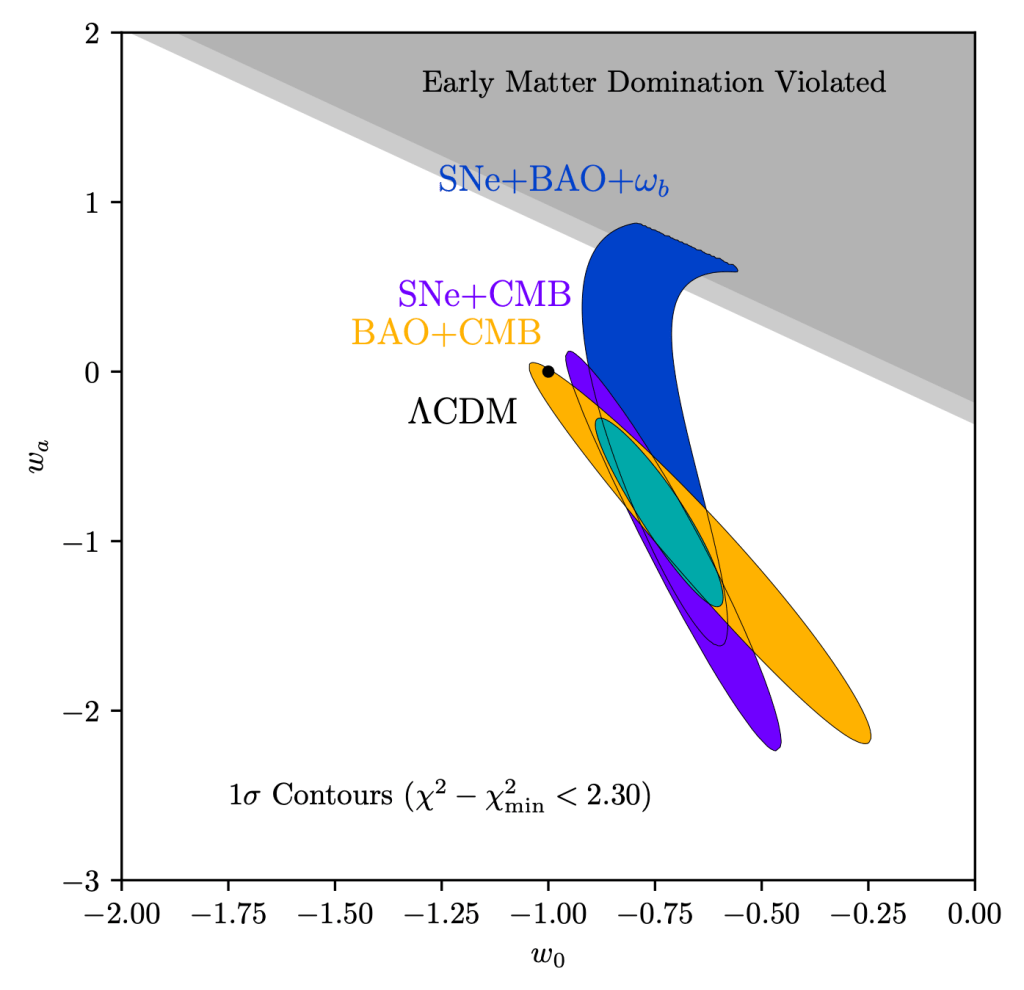
Punchlines: The luminosity difference with host-galaxy stellar mass is now consistent with zero (0.2% +- 1.2%), robust across different model variations! We still regress this out, just in case. The evidence for time-evolving dark energy decreases a bit (to about 3 sigma).

On to the next generation of surveys (the Vera C. Rubin Observatory, and the Nancy Grace Roman Space Telescope) and sub-percent precision!
Is the long freeze melting? Evaluating the case for and against thawing dark energy in light of the new DESI results

With the new DESI results (https://www.desi.lbl.gov/2024/04/04/desi-y1-results-april-4-guide/), it seems like time to write a short post on the case for thawing dark energy with a focus on the type Ia supernova (SNe Ia) side of things as that’s what I work on. (Thawing dark energy is dark energy that was locked into cosmological-constant-like behavior for much of the expansion of the universe, and then its equation of state parameter began to move higher than -1 and its density began to decrease.)

Let’s start with the case *against* thawing dark energy:

  1. The standard for new discoveries is frequently quoted as 5 sigma (that is, the evidence of new physics should be five times the estimated standard deviation of the measurement or about 1,000,000 to 1 in favor of new physics). Why this high standard? 5 sigma provides some robustness against misestimated uncertainties or non-Gaussian uncertainties (5 sigma may be less than 1,000,000 to 1 if the uncertainties are not Gaussian). It also helps mitigate the look-elsewhere effect (not very relevant here, we have been looking at w0 and wa for decades). Finally, aiming for 5 sigma provides a statistical penalty when adding more parameters to the model (relevant here for new parameters w0 and wa, but not always). These latest results are somewhat less than 5 sigma, varying from 2.5 sigma to 3.9 sigma, depending on the SN dataset considered.
  2. The SN Ia results rely heavily on two-parameter standardization (each SN has a fitted color and light-curve shape that are used to standardize); we know there are additional physical parameters that should be taken into account (e.g., https://arxiv.org/abs/2207.07645) but currently lack the data for most SNe to be able to do so. One sign that we are getting things wrong is that there is a correlation between “standardized” luminosity and the stellar mass/stellar age of the host galaxy. These correlations are modeled as part of the cosmology analyses, but due to “regression dilution” (regressing on something that imperfectly correlates with the parameters we should be regressing on) we may not be removing host-galaxy effects completely.
  3. The current nearby-SN datasets are a bit of a mess. They show varying combinations of: being hard to tie to the high-redshift data because of missing calibrations, having moderate disagreements in SN distances when multiple groups measure the distance to the same SN, and having selection effects that can be hard to model.

Ambiguous:

  1. The tension between distance-ladder and early universe Hubble-constant (H_0) values, which has crossed 5 sigma in some analyses (e.g., https://arxiv.org/abs/2112.04510). The simplest thawing models one would write down do not seem to impact H_0 much.

The case *for* thawing dark energy:

  1. Thawing dark energy is reasonably plausible. Cosmologists have been writing down simple models of scalar-field dark energy for decades that produce results like these (https://arxiv.org/abs/astro-ph/9708069). One still may have coincidence problem (why is the scalar field comparable to the matter density now, and why did it recently start rolling?), but a cosmological constant suffers similar problems.
  2. The nearby SNe are not obviously driving the tension in Union3+UNITY1.5. And the Amalgame dataset (https://arxiv.org/abs/2309.05654) dispenses with the nearby SN datasets altogether, looks at mostly non-overlapping SN data, and still finds consistent results (with larger uncertainties).
  3. The signature of thawing dark energy is fainter SNe at low redshift, which is the opposite of claimed luminosity evolution. So we would have to be overcorrecting somehow, which is really hard to believe in the face of regression dilution (https://arxiv.org/abs/2109.02456).
  4. Multiple SN analyses get broadly consistent results (Pantheon+ gives 2.5 sigma: https://arxiv.org/abs/2202.04077, Union3+UNITY1.5 gives 3.5 sigma: https://arxiv.org/abs/2311.12098, DES gives 3.9 sigma: https://arxiv.org/abs/2401.02929). All of these were blinded analyses (that is, the analyses were finalized without seeing the cosmology results, so we could not unconsciously tune the analyses to a preferred outcome). Do you prefer Bayesian forward modeling or simulation-based inference? They both show signs of thawing.
  5. No one cosmological dataset seems to be to blame:
  • This is a 2.6 sigma result without SNe, so SNe alone are unlikely to be to blame.
  • The indications of thawing dark energy were already present even without the latest DESI results (see my last post https://davidarnoldrubin.com/2023/11/22/new-union3-unity1-5-cosmology-paper/) so DESI alone is unlikely to be to blame.
  • Even the combination SNe + Baryon Acoustic Oscillations + Big Bang Nucleosynthesis shows some signs of tension (without CMB constraints) so Planck is unlikely to be to blame (blue contours).

So either we got very unlucky with a statistical fluctuation or multiple cosmological probes are seeing something similar: thawing dark energy.

These are exciting times and there is vastly more data coming in the future!

(A final note: if we do discover a new form of dark energy, let’s not make Einstein’s mistake and set the cosmological constant back to zero. Dark energy may consist of more than one component, as hard as that will be to tease apart.)

New Union3 + UNITY1.5 Cosmology Paper!

Aloha,

I’m very excited to write about my latest paper (just submitted to the Astrophysical Journal), assembling a new compilation of SNe (“Union3”) and an updated version of my supernova Ia cosmology framework (“UNITY1.5”). https://arxiv.org/abs/2311.12098

UNITY1.5 is a Bayesian model that enables treating outliers (occasional contamination from non-Ia supernovae), selection effects (brighter supernovae are more likely to be found), light-curve shape and color populations and standardization relations, unexplained dispersion, and heterogeneous observations simultaneously. It gives somewhat larger (more conservative) claimed cosmological uncertainties than previous analyses.

Despite the larger assessed uncertainties, Union3+UNITY1.5 shows weak 1.7–2.6σ tension with ΛCDM and possible evidence for thawing dark energy (which could be a sign that some or all of dark energy is an unknown type of scalar field).

There is a lot of upcoming data to look forward to, and it will be interesting to see how this result evolves!

Marginal “Marginal evidence for cosmic acceleration from Type Ia supernovae”

Edit: This post has been expanded on here https://arxiv.org/abs/1610.08972

I’m not in the habit of publicly writing about papers. But this one has unfortunately been getting some press, so I thought I should weigh in. The work in question is “Marginal evidence for cosmic acceleration from Type Ia supernovae” (Nielsen et al. Scientific Reports 6). The claim of this paper is that the evidence for the accelerated expansion of the universe from SN Ia is weak (< 3 sigma). The central problem with this work is that it assumes a constant SN Ia population distribution with redshift (Equation 4) when selecting priors for x1 (light-curve shape, i.e., the parameter in the Phillips relation) and color. As shown below, these distributions vary in redshift, both because of selection effects (e.g., it is easier to discover bluer, more-luminous SNe at the higher-redshift end of a magnitude-limited survey), and intrinsic population drift (older galaxies host less-luminous SNe, before standardization). Brighter SNe at high redshift implies less distance (as an increasing function of redshift), which implies less acceleration.

color_vs_z

Clearly, one must take account of this properly, which means a model that includes both selection effects and intrinsic population drift (*cough* http://adsabs.harvard.edu/cgi-bin/bib_query?arXiv:1507.01602). Let’s say I take the simple step of using the basic model of Nielsen et al., but modeling each category of SN discovery (nearby, Sloan Digital Sky Survey, SuperNova Legacy Survey, Hubble Space Telescope) with its own population mean. (This is still a biased analysis, but again I wanted a simple change.) The chi^2 between, e.g., Milne and LambdaCDM increases from 11.61 to 16.84, pushing the Bayesian Information Criterion above 10 in favor of acceleration  (please don’t judge me for using these statistical measures, I just wanted something fast for the purposes of this post). There are other problems with the paper, like the “projection” in Figure 2, but incorrectly modeling the SN population as a function of redshift is the original sin.